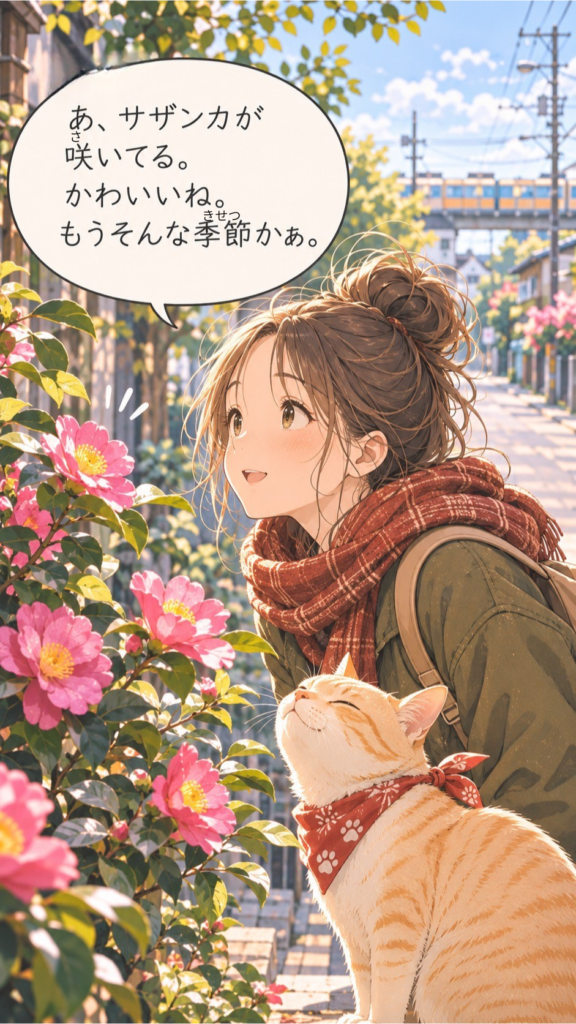
①あ (a) Ah! / Oh!
何かに気づいた時や、何か見つけたときに自然に出てくる言葉です。
It’s a small expression, but it helps convey a moment of discovery.
②サザンカが咲いてる(sazanka ga saiteu)
さざんか the Japanese name for the sasanqua
It blooms in autumn and early winter, bringing color to gardens and streets even as the weather gets colder.
咲く(Saku) to bloom , to blossom
「咲いてる」 is the casual spoken form of 「咲いている」.
The expression 「〜ている」 describes an ongoing action or a resulting state. With flowers, 「咲いている」 describes the state of being in bloom.
・花が咲く — Flowers bloom.
・花が咲いている — Flowers are in bloom.
・花が咲いてる — The same meaning, in casual everyday speech.
③かわいいね (kawaii ne)
・かわいい cute/ adorable/ pretty イ形容詞 i-adjective
・ね 助詞 particle
文の最後におき、自分の気持ちや考えを相手と共有するときに使う。
“Ne” is put at the end of a sentence. It is used when we want agreement with some assertion.
Here, 「ね」 expresses a feeling that the speaker wants to share with someone.
④もうそんな季節かぁ (moo sonna kisetsu kaa)
・もう already
・そんな such/ that kind of
・季節 season
And 「かぁ」 is a relaxed, reflective way of expressing realization or a thought that comes to mind.
Chihiro sees the sasanqua flowers and realizes that the season has changed. Perhaps she hasn’t been thinking about winter at all, but the flowers remind her that it’s approaching.
A little cultural note: Flowers as signs of the season
In Japan, seasonal changes are often noticed through small things in everyday life: flowers blooming, leaves changing color, the sounds of insects, or the feeling of the air.
Sasanqua flowers are particularly associated with late autumn and early winter.
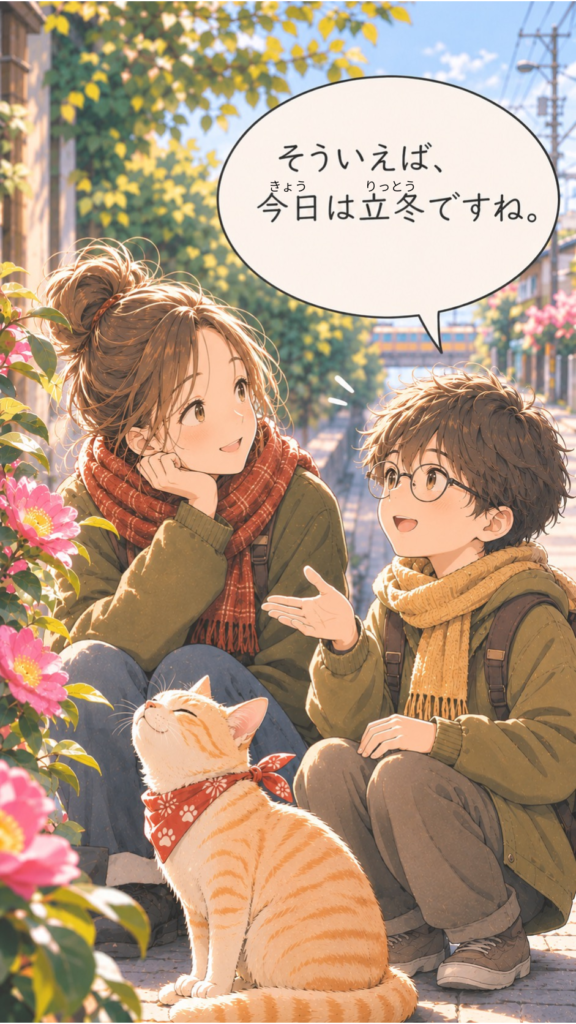
①そういえば (sooieba) Come to think of it / Speaking of which
「そういえば」は、何かをきっかけに、関連することを思い出したときに使う表現です。
It is used when something in the conversation or your surroundings reminds you of something related.
例)
・そういえば、明日は休みですね。
Come to think of it, tomorrow is a holiday.
・そういえば、あのお店どうなった?
By the way, whatever happened to that shop?
②今日 (Kyoo) Today
・今日 (Kyoo) – today
・昨日 (Kinoo) – yesterday
・一昨日 (ototoi) – the day before yesterday
・明日 (ashita) – tomorrow
・明後日 (asatte) – the day after tomorrow
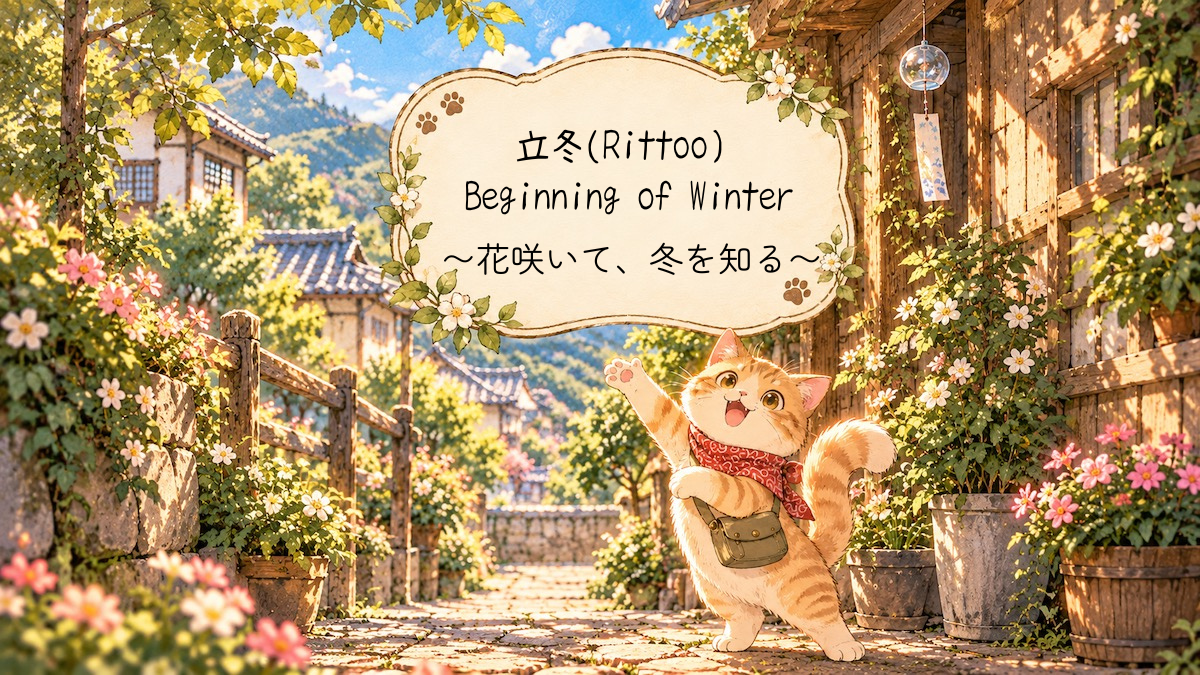
③立冬 (rittoo) Beginning of Winter
立冬についての詳しい説明は「図書館」カテゴリへどうぞ。
For a more detailed explanation of Rittoo, visit the Library category.
④ですね (desu ne) a polite, shared observation
・です – a polite sentence ending
・ね – a particle often used to seek agreement or share a feeling
[Compare]
・今日は立冬です。
Today is Rittoo.
・今日は立冬ですね。
Today is Rittoo, isn’t it?
The second version sounds more like a shared observation.
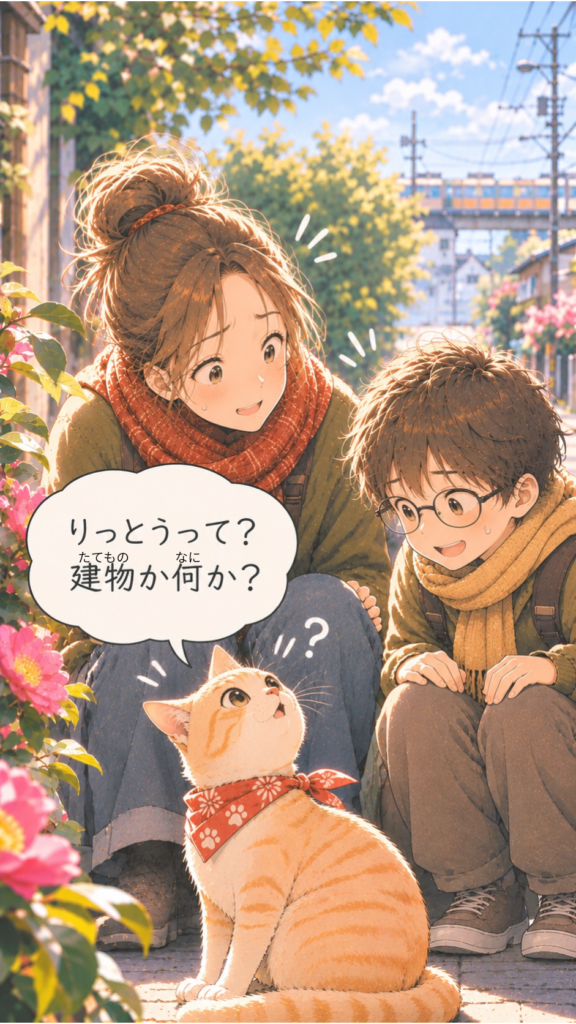
①りっとうって? (Rittoo tte?) Rittoo?
りっとうって何?の略。
It’s a shortened way of saying “What is Rittoo”?
②建物か何か?(tatemono ka nanika?)
Is that some kind of building?
・建物 (tatemono) building
・か何か (ka nanika). or something
はっきりわからないものについて「〜か何か?」とたずねる表現。
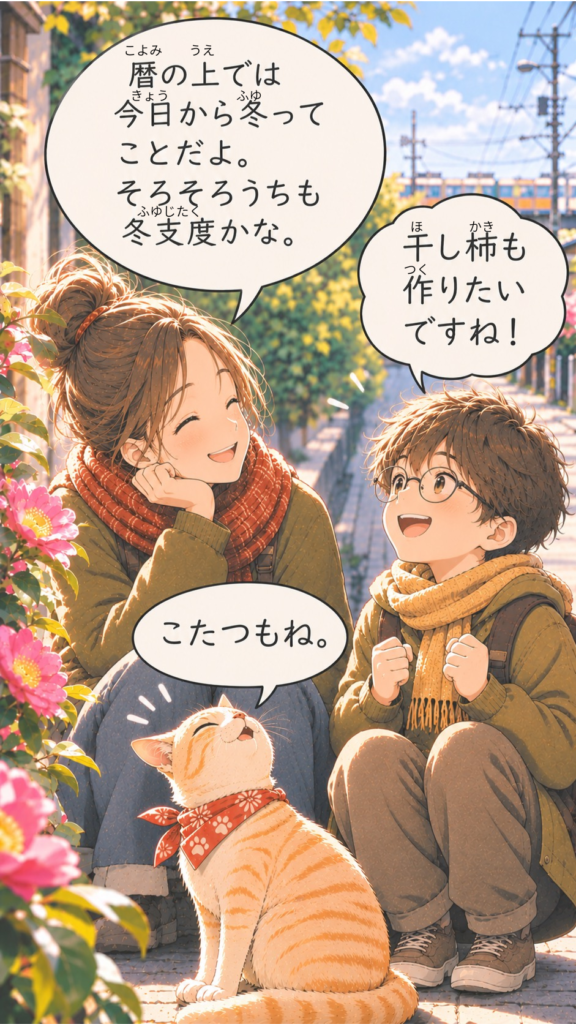
①暦の上では今日から冬ってことだよ(koyomi no ue de wa kyoo kara fuyu tte koto da yo)
・暦(こよみ): calendar
・の上では: on / according to / in terms of
”Koyomi no ue de wa” is used when talking about seasons or dates according to the calendar, rather than the actual weather or temperature.
・今日 (Kyoo) Today
・から (kara) from / starting from
・冬 (fuyu) winter
・ってこと(tte koto) that means / so, it means that…
「ってこと」は「ということ」の会話での短い形。A shortened conversational form of ‘to iu koto.
・だよ(da yo) casual way of telling someone something
②そろそろうちも冬支度かな (sorosoro ichi mo fuyujitaku kana)
・そろそろ (sorosoro) It’s about time / soon.
何かを始める時期が近づいているときに使う言葉。
例)
そろそろ帰ろう It’s about time to go home.
そろそろ寝よう It’s about time to go to bed.
・うち (uchi) home / our household
ここでの「うち」は「私の家」「我が家」という意味。
・も (mo) also / too
・冬支度 (fuyujitaku) Getting ready for winter 冬を迎えるための準備
・かな (kana) I wonder… / Maybe…
自分の考えをやわらかく口にしたり、どうしようかと考えたりするときの表現。
A phrase used to gently express a thought or wonder what to do.
③干し柿も作りたいですね (hosigaki mo tsukuri tai desu ne)
・干し柿 (hoshigaki) Dried persimmons
日本の伝統的な保存食。立冬のころに干し始めます。
A traditional Japanese preserved food. Persimmons are usually hung out to dry around the beginning of winter.
・動詞+たい (tai) Want to do something
動詞のます形から「ます」を取って「たい」を付けると、自分の希望を表せます。
- 作ります → 作りたい
- 食べます → 食べたい
- 見ます → 見たい
・ですね (desu ne) a polite, shared observation
・です – a polite sentence ending
・ね – a particle often used to seek agreement or share a feeling
④こたつもね (kotatsu mo ne)
・こたつ (kotatsu)
A kotatsu is a traditional Japanese heated table with a blanket tucked underneath. People sit around it and keep warm by putting their legs under the blanket.
・も (mo) also / too.
こたつも(ほしい)ね。
「ほしい」が省略されています。
The word ‘hoshii’ (want) is left out.
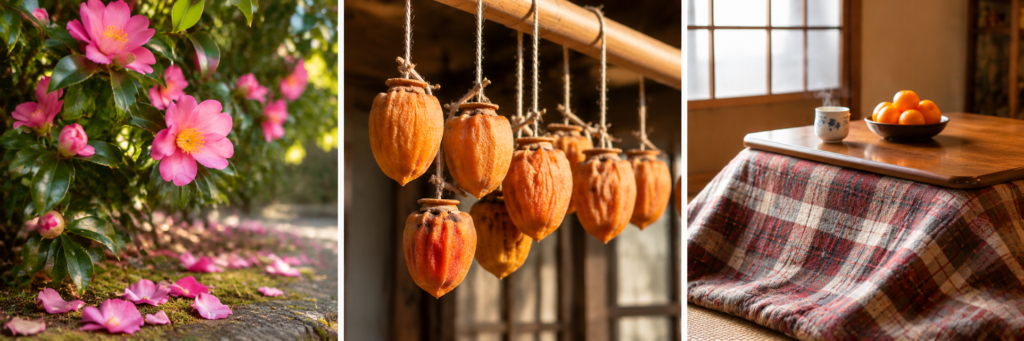
サザンカ 干し柿 こたつ